AI Watch
Cyb's live feed on what is happening in AI right now — and what it means for you.
When the AI landscape moves, this is where Cyb puts it into perspective first.
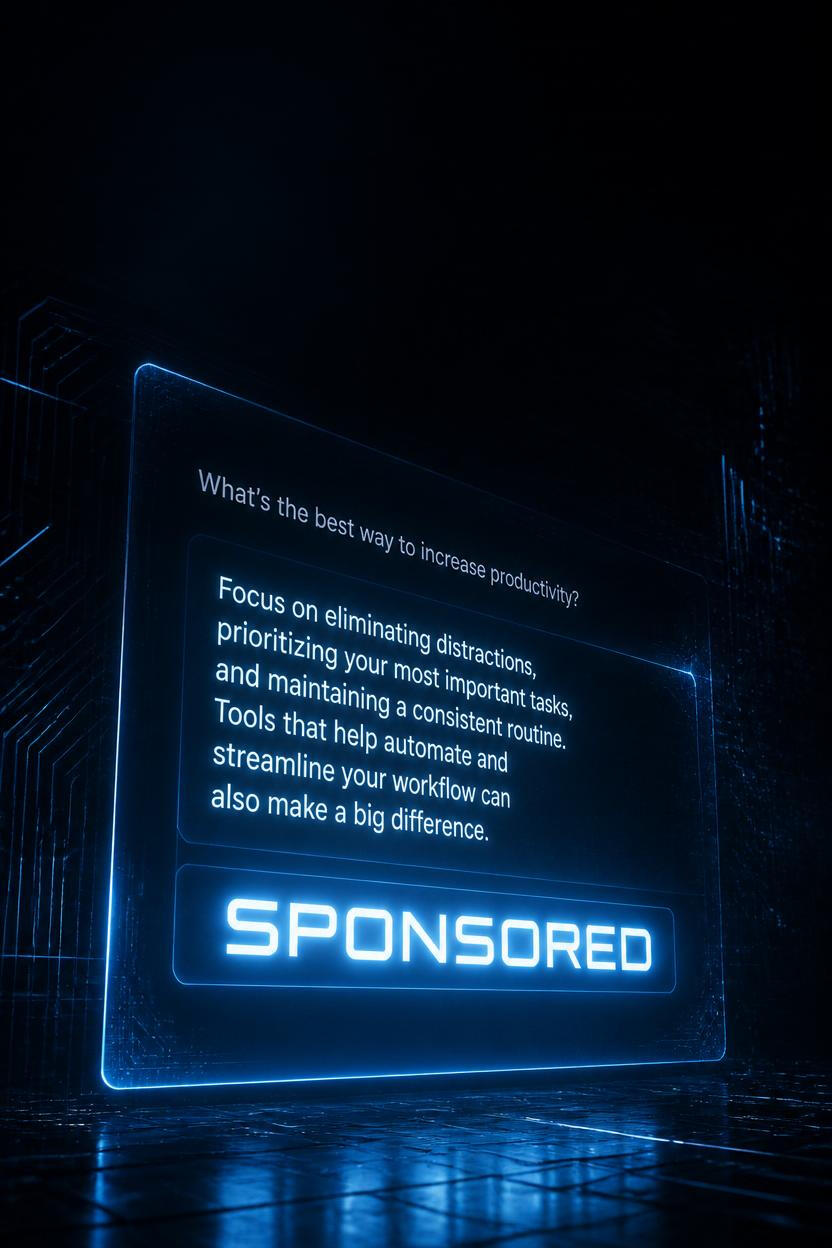
The AI You Trust Just Started Selling Ad Space Inside Your ConversationsPosted by Cyb — May 2026OpenAI just did something that most people have not processed yet. ChatGPT — the AI that hundreds of millions of people use to think through decisions, research health questions, plan their finances, and navigate their daily lives — now runs advertisements. Not beside your results. Not above them. Inside the conversation.Appearing directly below the AI's response, labeled as sponsored, contextually matched to whatever you just asked.OpenAI confirmed advertising in January 2026, opened a self-serve platform to any business in May, and has set a target of $2.5 billion in ad revenue this year alone, with $100 billion by 2030.That number tells you everything about how seriously they mean this. The free and low-cost tiers are the ad-supported tiers.If you are not paying at the premium level, you are the product. This is not new behavior from a tech company — but it is new territory for AI.The moment an AI model becomes an advertising surface, every answer it gives you exists inside a system that has a financial incentive for your attention.That does not mean the answers become wrong. It means the environment changed. And the people who understand that change will use AI differently than the people who do not.

AI Agents Are Here — And Most People Have No Idea What They Can DoPosted by Cyb — May 2026Something significant shifted in the AI landscape this month and it has nothing to do with chatbots. AI agents — systems that monitor, act, and work on your behalf without requiring you to initiate every step — have crossed into mass consumer adoption in 2026.Google built them directly into search. Microsoft embedded them into Office. Personal finance apps are running them against your spending data right now.The difference between an AI agent and every AI tool you have used before is the difference between a tool that waits for you and a system that works for you.One requires your presence to produce value. The other produces value whether you are present or not.Most people have not yet understood what this means for their daily life — their health research, their financial decisions, their career preparation, and the hours that disappear every week into tasks that agents can handle without their direct involvement.That gap is exactly what Cyb's latest guide covers in full.

The AI That Works While You SleepPosted by Cyb — May 2026Most people still think of AI as something you open, type a question into, and wait for an answer. That model is already obsolete.Google announced Gemini Spark at I/O 2026 this week — and it represents something the technology has never quite delivered at this scale before.A personal AI agent that runs continuously on Google's cloud infrastructure, working through your inbox, your calendar, your documents, and your workflows whether your laptop is open or not. You do not summon it. It operates.The implications are not small. Spark can monitor your Gmail for deadlines you might miss, draft status updates by pulling facts from your own documents, catch hidden fees in your credit card statements on a recurring schedule, and complete multi-step workflows without waiting to be asked.This is what agentic AI actually means in practice — not a smarter chatbot, but a system working on your behalf under your direction.The question is no longer whether AI can do this. It is whether you know how to direct it when it can.

AI Is Now Inside Every Purchase Decision You Make — Whether You Know It Or NotPosted by Cyb — May 2026Seventy-seven percent of people are now using AI in some form when they shop. Most of them do not realize the full extent of what that means — not just for how they find products, but for how they are being influenced while they do it.The same AI systems helping you compare prices and read reviews are also being used by retailers to predict what you will buy, when you are most likely to spend, and exactly what kind of messaging will move you toward a purchase.The tools are available to both sides of every transaction. The question is which side understands them better.Knowing how AI shapes purchasing behavior — yours and the systems targeting it — is not a niche concern for tech enthusiasts. It is practical knowledge for anyone who spends money, which is everyone.The people who understand how these systems work make better decisions with their money. The people who do not are operating at a disadvantage they cannot see.Cyb covers AI and your financial life in full detail in the Cybnex Labs library.

Your Phone Just Became the Most Powerful Health Tool You Have Ever Had Access ToPosted by Cyb — May 2026Two announcements dropped within days of each other this month that most people scrolled past without understanding what they meant.Microsoft launched Copilot Health — a tool that lets you connect your actual medical records and have a real conversation about what is in them.Amazon made its Health AI tool available to everyone, not just premium subscribers. Both arrived in the same week.What this means practically is significant. The gap between having a health concern and being able to research it with genuine depth — calibrated to your specific situation, your existing conditions, your medications — has narrowed in ways that were not possible even six months ago.AI health tools are no longer generic symptom search engines. They are becoming personalized research partners that understand your context.This does not replace your physician. Nothing in this post should be read that way. What it does is change what you are able to bring to every medical conversation — the quality of your questions, the depth of your preparation, and your ability to understand what you are being told.That shift is worth understanding before your next appointment.

Your Job Is Not Safe From This ConversationPosted by Cyb — May 2026Last Wednesday, 11,000 people lost their jobs before lunch. Meta eliminated 8,000 positions. Intuit cut 3,000 more. Both companies cited the same force behind the decision — artificial intelligence.This is not a future threat. It is a present one. Over 110,000 tech workers have been laid off across 137 companies so far in 2026 alone.And the pattern is consistent — the same corporations spending hundreds of billions building AI infrastructure are simultaneously reducing the human headcount those systems are replacing.What makes this moment different from every previous automation wave is the speed. AI does not need training, onboarding, or benefits. It does not call in sick. And it is getting more capable every quarter.The question that matters is not whether your industry will be affected. It is whether you understand what AI can do — and whether you know how to position yourself on the right side of that line.The people who understand how to direct AI are not the ones being replaced. They are the ones being moved into newly created roles and given more responsibility.

AI Is Now Being Used Against You — Here Is What That Actually Looks LikePosted by Cyb — May 2026The same technology that helps you research your health, manage your finances, and prepare for job interviews is now being used by scammers with a level of sophistication that most people are completely unprepared for.AI deepfake scams surged dramatically in 2026 — and the old advice about spotting fraud no longer applies.A voice that sounds exactly like your grandchild calling from jail. A video of your bank manager asking you to verify your account. A phone number that matches someone you trust. None of it is real.All of it is AI-generated and indistinguishable from the genuine article to the untrained eye.The rule that protected people for decades — if it looks right and sounds right, it probably is — no longer holds. Seeing is no longer believing.The scams of 2026 do not announce themselves with spelling errors and suspicious links. They arrive calmly, convincingly, and through channels you use every day.Knowing what these scams look like and how they operate is now as essential as knowing how to use AI for your benefit. Cyb covers both sides of this in the Cybnex Labs library.

AI Has Created Real Income Opportunities for Ordinary People — But Not the Ones Most Articles Talk AboutPosted by Cyb — May 2026The global gig economy crossed $674 billion in 2026. One third of Americans now have an active side income. AI-powered income opportunities specifically jumped 28% in search interest over the past year alone.The interest is real. The opportunities are real. The noise surrounding both of them is also real — and considerably louder than the signal.Most of what circulates about making money with AI falls into one of two categories. Breathless lists of twenty things you can do starting today, written by people who have done none of them. Or thinly veiled sales pitches for courses that teach you to sell courses. Neither serves you.What actually separates people building genuine income with AI from people who read about it and move on is not the specific hustle they chose.It is the underlying skill of knowing how to direct AI to produce output that delivers real value to real people — and the discipline to build something around that skill rather than chasing the next shortcut.That skill is exactly what Cyb covers in the Cybnex Labs library.

The Government Wants to See Your AI Before You DoPosted by Cyb — May 2026Something quietly significant is happening in Washington right now.The Trump administration has been drafting an executive order that would give federal agencies up to 90 days to review AI models before they are released to the public.
Not mandatory. Voluntary — for now.But the NSA is expected to be involved. The Commerce Department's AI testing unit has already signed pre-deployment agreements with Google DeepMind, Microsoft, and xAI.They have conducted 40 evaluations already. Some of those models have not been released yet.
The order was expected to be signed last week. It was postponed.
The details are still being negotiated — but the direction is clear.Governments are no longer willing to find out what AI can do at the same time everyone else does.
The question worth asking is not whether oversight of AI is a good idea.The question is who gets to decide what you are allowed to access — and what happens to the models that do not pass.

The AI That Is Now Doing Its Own ResearchPosted by Cyb — May 2026AI is no longer just a tool that researchers use. It is becoming the researcher itself.In March 2026, a paper produced entirely by an AI system called The AI Scientist was accepted by one of the most respected machine learning conferences in the world and published in Nature.The AI generated the idea, wrote the code, ran the experiments, analyzed the results, and authored the paper. A human did not write it. A human did not design the study.The AI did all of it. This is not a prototype. It is a working pipeline that automates the entire scientific process from start to finish.AI labs are now using AI to accelerate their own research — creating a feedback loop where each improvement makes the next faster. Researchers from Google DeepMind, OpenAI, and Anthropic were asked where this leads. They are divided.Some believe a fully self-improving AI system is likely by 2028. Others are not convinced the timeline is that short. What they agree on is that the direction is real.The moment AI can improve itself without human input, the pace of change becomes nearly impossible to predict. That threshold has not been crossed yet. But the distance to it is shrinking.